What this article covers
- Why you should not treat the biggest SEO site or the most-mentioned AI brand as your default GEO benchmark.
- How to use mention coverage, indexed-page scale, AI traffic sources, and curve comparisons to screen better competitors.
- Why a site dominated by Google AI Overview traffic is often SEO-led GEO, not native GEO distribution.
- Why Fish Audio is one of the strongest GEO reference cases in AI.
- Why YouTube, Reddit, and third-party blogs often matter more than website size alone.
One of the easiest mistakes in GEO competitor analysis is picking the site with the most SEO traffic or the highest AI mention count. Those sites may look impressive, but that does not automatically mean they built GEO intentionally.
A brand can appear in ChatGPT, Perplexity, or Google AI Overview simply because it already ranks well in search, owns a large number of indexable pages, or gets pulled into AI answers through existing Google results. If we study that kind of site blindly, we often end up learning classic SEO instead of true GEO.
A GEO competitor worth studying is not just a high-ranking site. It is a brand that has built a standalone knowledge network strong enough to shape model answers beyond traditional search.
Why the biggest SEO site is not automatically the best GEO benchmark
A site can show up in AI products for reasons that have little to do with native GEO work. It may already have strong rankings, a large searchable footprint, or a content structure that Google can easily reorganize into AI Overview.
- Its SEO traffic was already high before AI traffic showed up.
- It owns a large number of pages that are already indexed by Google.
- AI products are reading existing search results rather than a separate brand knowledge network.
- A meaningful share of the so-called AI traffic may actually come from Google AI Overview.
That is why the real goal is not to find the biggest site. The better goal is to find the brand that generates dense AI visibility from a relatively limited content base.
1. Compare AI mentions against effective indexed pages
The first useful screen is the relationship between brand AI mentions and the site's effective indexed pages. If a site only has a few hundred valuable indexable pages but appears repeatedly in AI answers, its visibility is probably not explained by website size alone.
AI mention coverage = AI mention count ÷ effective indexed page count
The closer that ratio gets to 1, the more tightly the site's searchable content footprint maps to how often the brand appears in AI answers. If the mention count is high relative to page count, that can also signal strong off-site discussion across YouTube, Reddit, review sites, GitHub, media coverage, and niche communities.
The five metrics worth comparing together
| Metric | Why it matters |
|---|---|
| Total AI mentions | Shows overall answer frequency across prompts |
| Unique cited pages | Shows how many content assets models actually use |
| Effective indexed pages | Shows real searchable content scale |
| Off-site cited pages | Shows whether GEO depends on external knowledge sources |
| Mention-to-index ratio | Shows how efficiently each page turns into AI visibility |
Do not use this ratio alone. Mention counts can include repeated brand appearances across prompts, and indexed pages can include low-value URLs like logins, docs clutter, or duplicate locale pages.
2. Check whether ChatGPT is the main AI traffic source
Do not stop at a generic AI Traffic number. Break it down by source: ChatGPT, Perplexity, Gemini, Claude, Copilot, and Google AI Overview.
The key question is simple: are independent AI products driving most of the AI referrals, or is the traffic mostly coming from Google AI Overview?
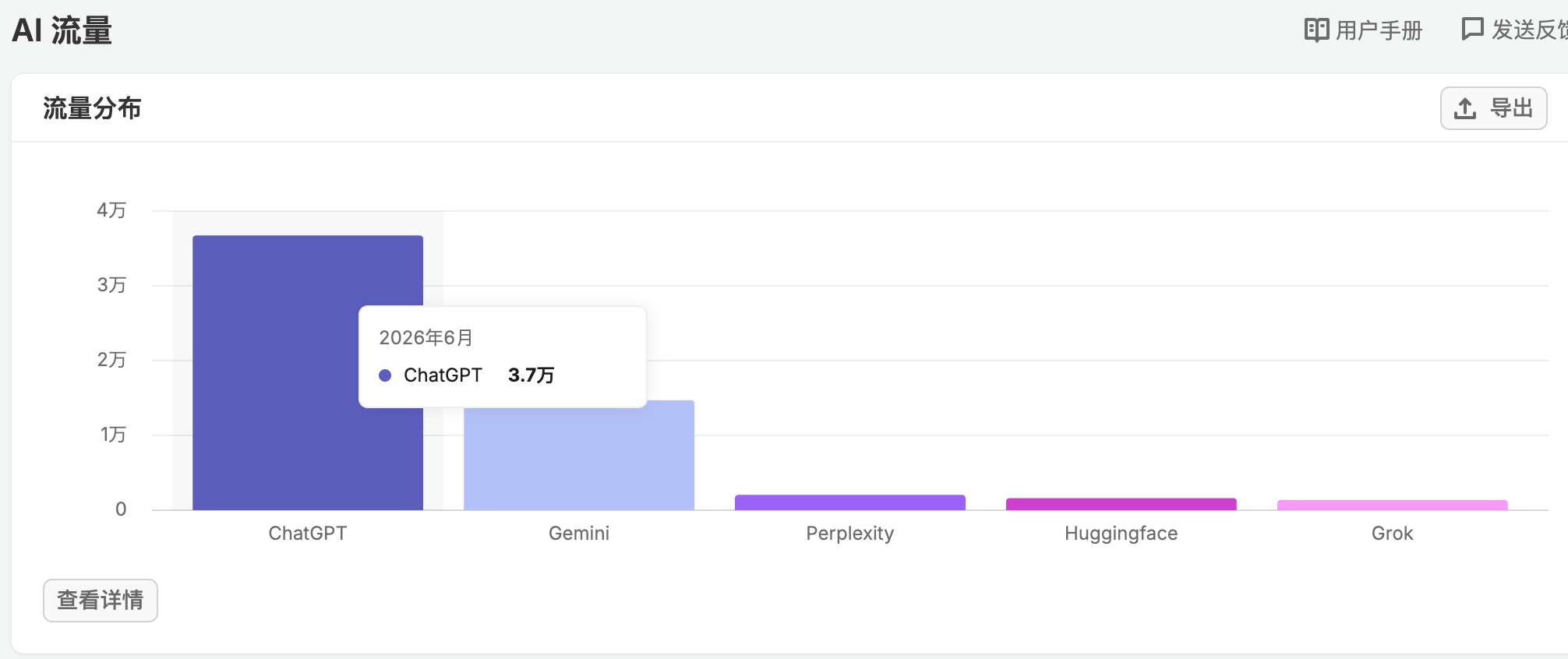
Two types of GEO competitors
| Type | Primary traffic source | Core driver | Best use as a benchmark |
|---|---|---|---|
| SEO-led GEO | Google AI Overview | Rankings, indexed pages, and page authority | Best for learning SEO structure |
| Native GEO-led | ChatGPT, Perplexity, and other independent AI products | Brand mentions, community discussion, third-party validation | Best for learning true GEO distribution |
A useful shortcut
If most of the GPT-facing AI traffic is actually explained by Google AI Overview, you should usually treat that site as SEO-led GEO, not as a pure GEO distribution case.
3. Compare the SEO curve and the GEO curve
One of the best ways to tell whether a brand invested in GEO separately is to compare two lines on the same timeline: SEO traffic from search engines and GEO or AI traffic from products like ChatGPT, Perplexity, and Gemini.
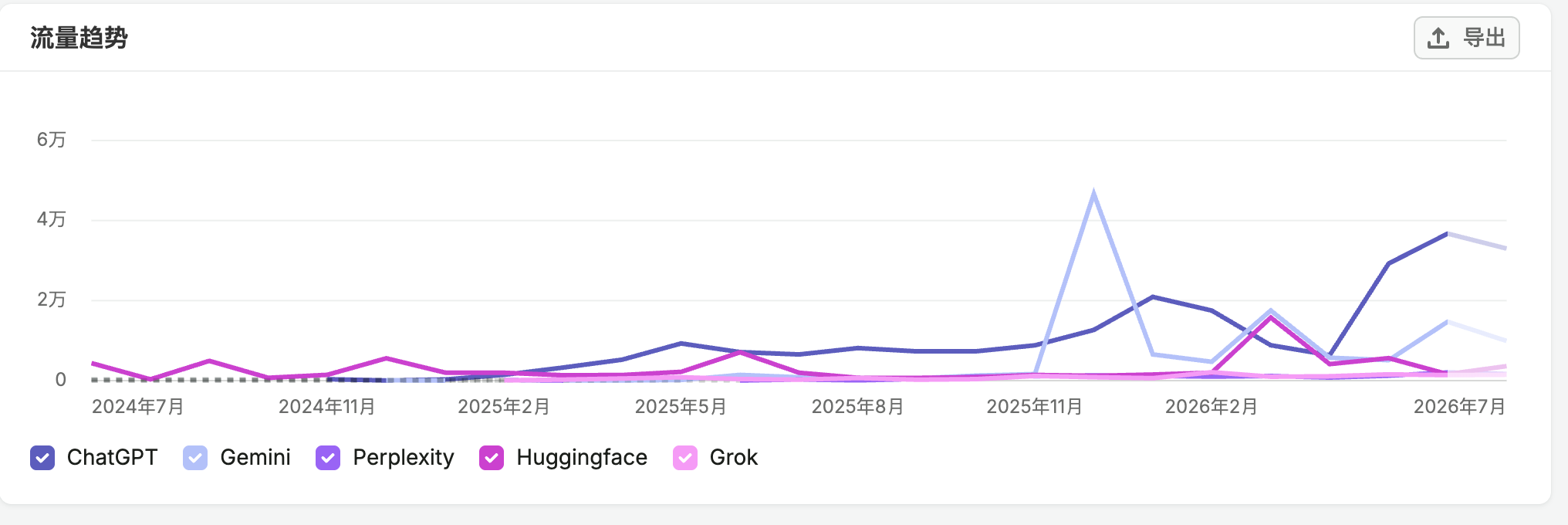
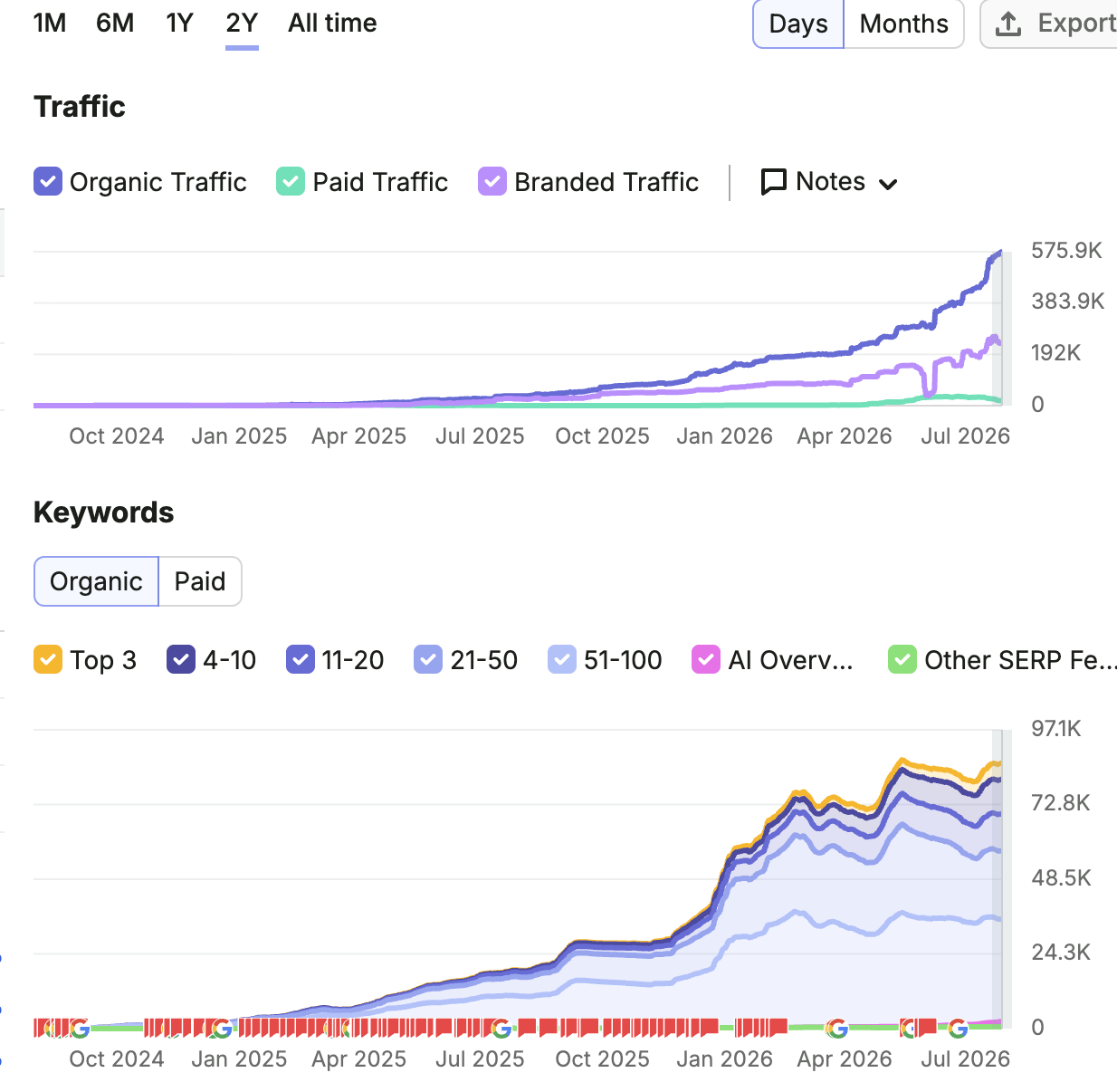
Three curve patterns to look for
The lower the overlap between the SEO curve and the GEO curve, the more interesting that site usually becomes as a native GEO benchmark.
4. Why Fish Audio is a strong GEO reference case
Fish Audio is valuable not just because of how much traffic its site receives, but because of how many independent platforms help describe, validate, compare, and demonstrate the brand.
Using Fish Audio as the reference, the real signal is not that one page ranks well. The stronger signal is that the brand keeps showing up outside its own website across YouTube, Reddit, and third-party content environments. That makes it a better GEO benchmark because it reflects brand-level visibility rather than page-level rankings alone.
Using Fish Audio as an example, how SEO growth differs from GEO growth
- ✓Which page ranks
- ✓How many keywords each page covers
- ✓How many backlinks the site has
- ✗Overall brand visibility and exposure across the web
- ✗Whether the brand keeps appearing across YouTube, Reddit, and third-party content
- ✗Whether users and creators keep mentioning the product in multiple contexts
- ✗Whether the brand has built recognition beyond its own site
5. Why YouTube and Reddit matter so much
Among third-party platforms, the two most important Fish Audio sources are YouTube and Reddit. That points to two especially strong GEO levers: creator distribution and community discussion.
For AI voice products, YouTube creates verifiable product experience. Prospects can hear the output, compare quality, watch tutorials, see new-model tests, and understand use cases through creator language instead of brand copy alone.
- Product reviews and hands-on walkthroughs
- Fish Audio vs ElevenLabs comparisons
- Tutorials and new-model tests
- Voice-cloning output demos
- Real creator reactions and scenario-based evaluations
Reddit adds a different kind of signal. A single thread can contain a user problem, multiple product recommendations, praise, criticism, feature tradeoffs, competitor comparisons, and a long tail of follow-up comments. That makes Reddit look much more like a living knowledge layer than a static article.
- What situations users recommend the product for
- Which competitors it gets compared against
- Which features are mentioned repeatedly
- What consensus the market is forming
- Where the product still faces objections or debate
From a GEO perspective, YouTube helps build verifiable experience while Reddit helps build scalable, multi-perspective discussion. When both are active, the model has much more evidence to recognize and recommend the brand.
6. A practical GEO competitor screening workflow
- Build a candidate list based on similar product type, similar buyers, repeated ChatGPT recommendations, visible AI traffic growth, and strong off-site discussion.
- Compare AI mentions against index scale by logging total mentions, unique cited pages, effective indexed pages, mention-to-index ratio, and off-site citation share.
- Break down AI traffic sources and check whether ChatGPT is dominant or whether Google AI Overview explains most of the traffic.
- Overlay SEO and GEO curves to see when growth starts, how steep it is, how much the curves overlap, and whether GEO remains stable after SEO shifts.
- Break citation sources into owned pages, YouTube, Reddit, third-party blogs, media, technical sources, and review platforms to see which channels actually built the brand entity.
7. What a truly valuable GEO competitor usually looks like
- High AI mention scale relative to indexed page scale
- Independent AI products such as ChatGPT as the primary AI traffic source
- Low dependence on Google AI Overview
- A GEO curve that does not fully overlap with the SEO curve
- Visible brand discussion and recognition outside the company website
The weakest benchmark to copy
A site with a huge SEO footprint and very strong Google rankings can still be a weak GEO benchmark if most of its AI traffic is just Google AI Overview reformatting search visibility.
Conclusion: the best GEO competitor is a multi-source brand, not just a high-ranking site
SEO is about getting pages into search results. GEO is about getting your brand, capabilities, and use cases into model answers. That is why the most useful GEO benchmark is not always the site with the most pages or the most traffic.
The stronger benchmark is the brand that already behaves like a knowledge network: the website provides facts, YouTube shows experience, Reddit captures discussion, third-party blogs handle comparison, and technical platforms add verification.
The final GEO test may be simple: if rankings shift tomorrow, will the model still know who you are, what you solve, and why it should recommend you?